
Arabic prenuptial lawyer in Connecticut
Looking for an Arabic prenuptial & mahr agreements lawyer near you in Connecticut? Connect with Arab prenuptial & mahr agreements attorneys trusted by Iraqi, Syrian, Lebanese & Palestinian families. Free consultation across Connecticut.


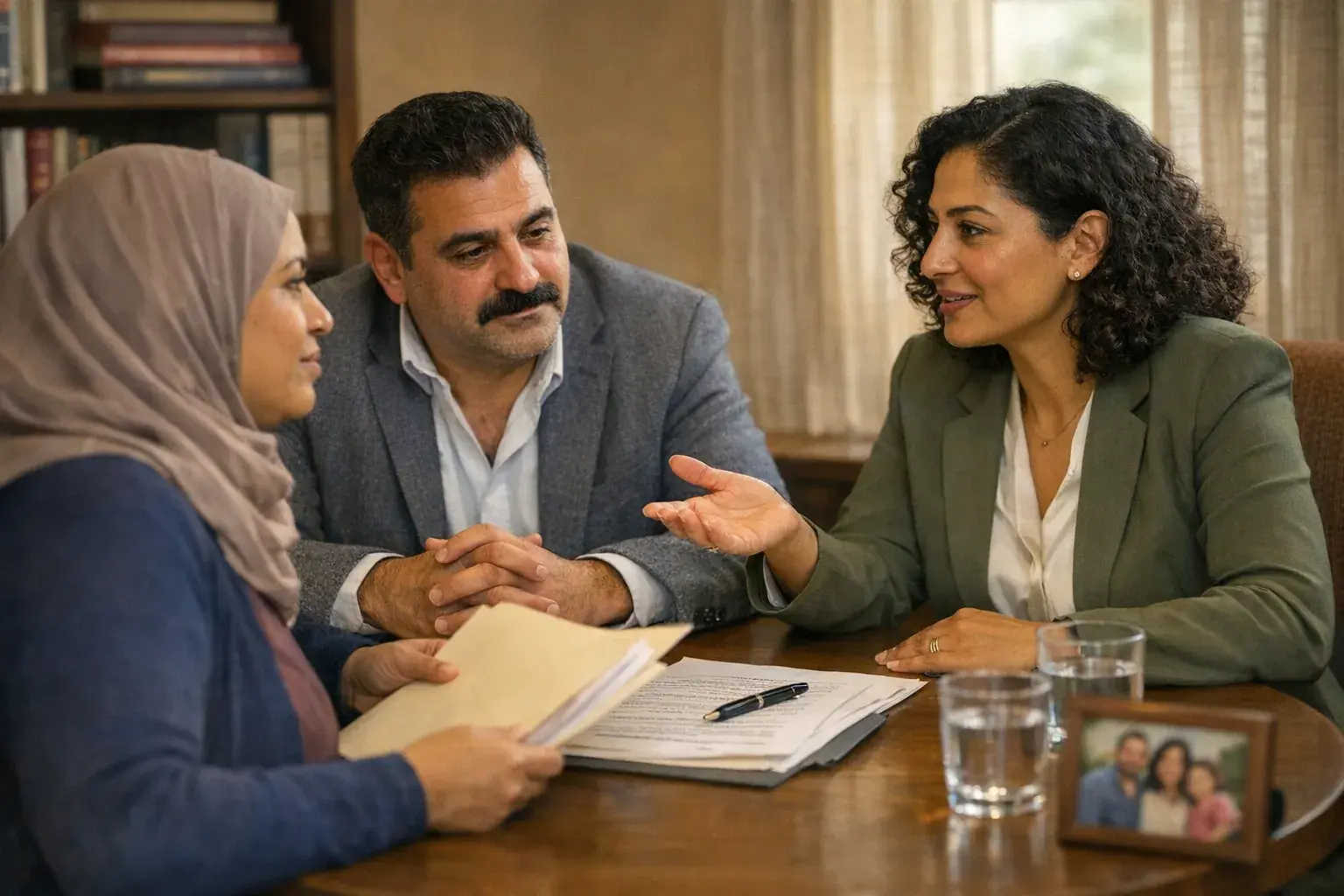
Arabic prenuptial & mahr agreements lawyers by Connecticut city
Find an Arab prenuptial & mahr agreements attorney near you. Iraqi, Syrian, Lebanese, Palestinian & all Arab lawyers in every Connecticut city.



Find an Arabic prenuptial & mahr agreements lawyer in Connecticut
Connecticut is home to an estimated 15,000+ Arab Americans, with significant communities in Bridgeport, New Haven, Waterbury, Hartford. Our network connects Lebanese, Egyptian, Palestinian, Syrian, and other Arab families with experienced Arabic-speaking prenuptial & mahr agreements attorneys across the state. These lawyers combine fluent Arabic communication with deep knowledge of Connecticut law, ensuring you can discuss your case in your preferred language without missing critical legal details.
Connecticut follows equitable distribution for marital property, meaning courts divide assets fairly but not necessarily equally — making skilled negotiation essential in prenuptial & mahr agreements cases. Connecticut courts have addressed mahr agreements — an Arabic-speaking family lawyer understands how to present these Islamic marriage contracts in ways Connecticut judges recognize. Connecticut courts prefer joint custody arrangements using the best-interests-of-the-child standard.
Why choose an Arabic-speaking prenuptial & mahr agreements attorney in Connecticut
Native Arabic communication
Discuss your prenuptial & mahr agreements case in Arabic without interpreters. Explain complex situations clearly and understand every detail of your legal options.
Cultural understanding
Work with attorneys who understand Arab family dynamics, cultural values, and how they relate to your prenuptial & mahr agreements case.
Connecticut prenuptial & mahr agreements experience
Lawyers with deep experience handling prenuptial & mahr agreements cases in Connecticut courts under Connecticut law.
Built for the community
Every attorney in our Connecticut network is licensed and Arabic-speaking, with experience in prenuptial & mahr agreements cases.
Get a free consultation with an Arabic prenuptial & mahr agreements lawyer in Connecticut
All consultations with Arabic prenuptial & mahr agreements lawyers in our Connecticut network are completely free and confidential. During your consultation, you'll discuss your prenuptial & mahr agreements situation in Arabic with a qualified attorney who can explain your legal options clearly.
Phone or video
Speak with a lawyer from anywhere in Connecticut
Quick response
Most consultations within 24 hours
No cost to you
Free initial consultation guaranteed
Arabic prenuptial & mahr agreements lawyer services in Connecticut
Islamic marriage contract expertise including prenuptial agreements, mahr contracts, and postnuptial agreements.
Mahr expertise
Draft and enforce mahr agreements recognized by US courts.
Cultural alignment
Prenuptial agreements that respect Islamic traditions and US law.
Asset protection
Protect premarital assets, businesses, and family property.
Future security
Clear terms prevent costly disputes if circumstances change.
How much does an Arabic prenuptial & mahr agreements lawyer cost in Connecticut?
Legal fees for prenuptial & mahr agreements cases vary depending on the complexity and circumstances. Here's what to expect when hiring an Arabic-speaking prenuptial & mahr agreements lawyer in Connecticut:
Family law fee ranges:
- Prenuptial & Mahr Agreements: Varies by complexity
- Flat fee or hourly billing
- Payment plans available
- Free initial consultation
What's included:
- Mahr and Islamic contract review
- Court filing and representation
- Custody and support negotiation
- Property division strategy
* Fees are estimates and vary by case complexity. Get an exact quote during your free consultation.
Arab prenuptial & mahr agreements lawyer process in Connecticut
Our streamlined process gets you the help you need quickly and efficiently.
Initial Consultation
We discuss your goals, the mahr terms, property concerns, and business interests. Both parties should have independent legal counsel for the agreement to be enforceable.
Drafting the Agreement
We draft the agreement incorporating mahr terms, property provisions, and any other agreed-upon terms. The language satisfies both Islamic requirements and state prenuptial law.
Review, Negotiation & Execution
Both parties and their attorneys review the draft, negotiate any changes, and sign the final agreement. Proper execution is critical for enforceability.
Arabic prenuptial & mahr agreements lawyers in Connecticut for all nationalities
Our Connecticut network includes prenuptial & mahr agreements attorneys experienced with clients from every Arabic-speaking country. Whether you're from the Levant, Gulf, North Africa, or elsewhere, we'll match you with a lawyer who understands your specific background.
Plus attorneys familiar with Kuwaiti, Libyan, Sudanese, Somali, Chaldean, Assyrian, and other Middle Eastern communities

Book your free consultation today
Take the first step—select your legal matter below and get matched with an experienced Arabic-speaking attorney within 24 hours. No fees, no obligation.
How to find the best Arabic prenuptial & mahr agreements lawyer in Connecticut
Finding the right Arabic-speaking prenuptial & mahr agreements lawyer in Connecticut doesn't have to be difficult. Here's what to look for when choosing your attorney:
Verify Arabic language skills
Ask if the attorney speaks Arabic fluently. Can they explain complex prenuptial & mahr agreements concepts in Arabic?
Check prenuptial & mahr agreements experience
Look for attorneys with proven experience handling prenuptial & mahr agreements cases in Connecticut.
Read reviews from Arab clients
Look for testimonials specifically from Arab American clients who had prenuptial & mahr agreements cases.
Schedule a free consultation
Meet with the attorney before deciding. A free consultation lets you assess their expertise firsthand.
Connecticut family law overview
Understanding Connecticut's family law statutes helps you protect your rights and plan your case. Here's what you need to know.
Divorce Requirements
Adultery, Fraudulent contract, Willful desertion for 1 year, Habitual intemperance, Intolerable cruelty, Sentence to life imprisonment, Confinement for mental illness for 5 years
Connecticut allows both no-fault and fault-based divorce. The 90-day waiting period begins when the non-filing spouse is served. Connecticut has a unique "dissolution of marriage" proceeding that can address all issues — property, custody, and support — in a single action.
Property Division
Connecticut uses equitable distribution, dividing marital property fairly but not necessarily equally. Notably, Connecticut courts can divide ALL property owned by either spouse, including separate property acquired before marriage or received as gifts or inheritance. This "all-property" approach is broader than most states.
Connecticut's all-property equitable distribution system means the court has discretion to divide premarital and inherited assets. Mahr agreements may be analyzed under contract law principles. An Arabic-speaking family lawyer can help present the mahr as an enforceable contract.
Child Custody
Best interests of the child
Yes
- •The temperament and developmental needs of the child
- •The capacity and disposition of the parents to understand and meet the needs of the child
- •Any relevant and material information obtained from the child
- •The wishes of the child's parents
- •The past and current interaction and relationship of each parent with the child
Connecticut courts encourage joint custody unless it would be detrimental to the child. The court distinguishes between legal custody (decision-making) and physical custody (residence). A Guardian Ad Litem may be appointed to represent the child's interests in contested cases.
Child Support
Connecticut uses the income shares model based on both parents' combined net income, the number of children, and the parenting schedule. The state provides detailed guidelines and worksheets. Deviations from guidelines require specific findings by the court.
Support continues until age 18, or 19 if the child is still in high school. Connecticut courts can order post-majority educational support for college. The guidelines are reviewed and updated periodically by the Commission for Child Support Guidelines.
Alimony & Spousal Support
- •Temporary
- •Rehabilitative
- •Permanent
- •Lump-sum
- •The length of the marriage
- •The causes for the dissolution of the marriage
- •The age, health, station, occupation, amount and sources of income of each party
- •The vocational skills and employability of each party
- •The estate and needs of each party
- +1 more factors
Connecticut courts have broad discretion in awarding alimony. There are no fixed formulas, and the court considers the totality of the circumstances. Permanent alimony is available for long-term marriages. Connecticut is one of few states where marital fault can be considered in alimony awards.
Key Facts About Family Law in Connecticut
- 1No-fault divorce based on irretrievable breakdown (fault grounds also available)
- 290-day mandatory waiting period after service
- 3Equitable distribution — "all-property" approach (court can divide any asset)
- 4Joint custody encouraged unless detrimental to child
- 5Child support until 18 (or 19 if still in high school), college support possible
- 6Broad alimony discretion — fault can be considered
This information is for educational purposes only and does not constitute legal advice. Laws may change. Consult with an attorney for advice specific to your situation.
Questions to ask an Arabic prenuptial & mahr agreements lawyer in Connecticut
When you meet with an Arabic-speaking prenuptial & mahr agreements attorney for your free consultation, ask these important questions:
Directory
Family Law lawyers in Connecticut
Arabic-speaking attorneys serving the Arab community in Connecticut.
No Arabic-speaking family law attorneys listed in Connecticut yet.
Know an attorney who should be listed?
Recommend or join our networkArabic prenuptial & mahr agreements lawyer FAQs — Connecticut
Common questions about Arab prenuptial & mahr agreements attorneys in Connecticut
Are you an Arabic-speaking family law attorney in Connecticut? Join our network
Get matched with an Arabic-speaking prenuptial & mahr agreements attorney in Connecticut today
Looking for an Arabic prenuptial & mahr agreements lawyer near you? Connect with a Arabic-speaking Arab attorney in Connecticut. Free consultation, 24-hour matching, no obligation.
Disclaimer: The information on this page is for general educational purposes only and does not constitute legal advice. Connecticut laws may differ from other states. Each case is unique and outcomes depend on specific facts. Contact a qualified attorney for advice specific to your situation.