


A&
Abdelhadi & Associates
Dallas, Texas Arabic, English
Personal InjuryFamily LawImmigration
Practice Areas
Visas, green cards, citizenship & deportation defense
Car accidents, workplace injuries & malpractice
IRS audits, tax debt relief & international tax
Divorce, child custody, mahr & domestic violence
DUI, drug charges, assault & federal crimes
Contracts, LLC, commercial leases, franchise law
Coming Soon
Browse by location
Looking for an Arabic prenuptial & mahr agreements lawyer near you in Texas? Connect with Arab prenuptial & mahr agreements attorneys trusted by Iraqi, Syrian, Lebanese & Palestinian families. Free consultation across Texas.


Find an Arab prenuptial & mahr agreements attorney near you. Iraqi, Syrian, Lebanese, Palestinian & all Arab lawyers in every Texas city.
Texas is home to an estimated 400,000+ Arab Americans, with significant communities in Houston, Dallas, Austin, San Antonio. Our network connects Palestinian, Egyptian, Lebanese, Jordanian, and other Arab families with experienced Arabic-speaking prenuptial & mahr agreements attorneys across the state. These lawyers combine fluent Arabic communication with deep knowledge of Texas law, ensuring you can discuss your case in your preferred language without missing critical legal details.
Texas is a community property state, meaning marital assets are generally split 50/50 in divorce — a critical factor in prenuptial & mahr agreements cases. The state requires a 60 days from filing waiting period before a divorce is finalized. An Arabic-speaking family attorney in Texas understands mahr agreements, Islamic marriage contracts, and the cultural sensitivities around divorce and custody in Arab families. Texas courts prefer joint custody arrangements using the best-interests-of-the-child standard.
Discuss your prenuptial & mahr agreements case in Arabic without interpreters. Explain complex situations clearly and understand every detail of your legal options.
Work with attorneys who understand Arab family dynamics, cultural values, and how they relate to your prenuptial & mahr agreements case.
Lawyers with deep experience handling prenuptial & mahr agreements cases in Texas courts under Texas law.
Every attorney in our Texas network is licensed and Arabic-speaking, with experience in prenuptial & mahr agreements cases.
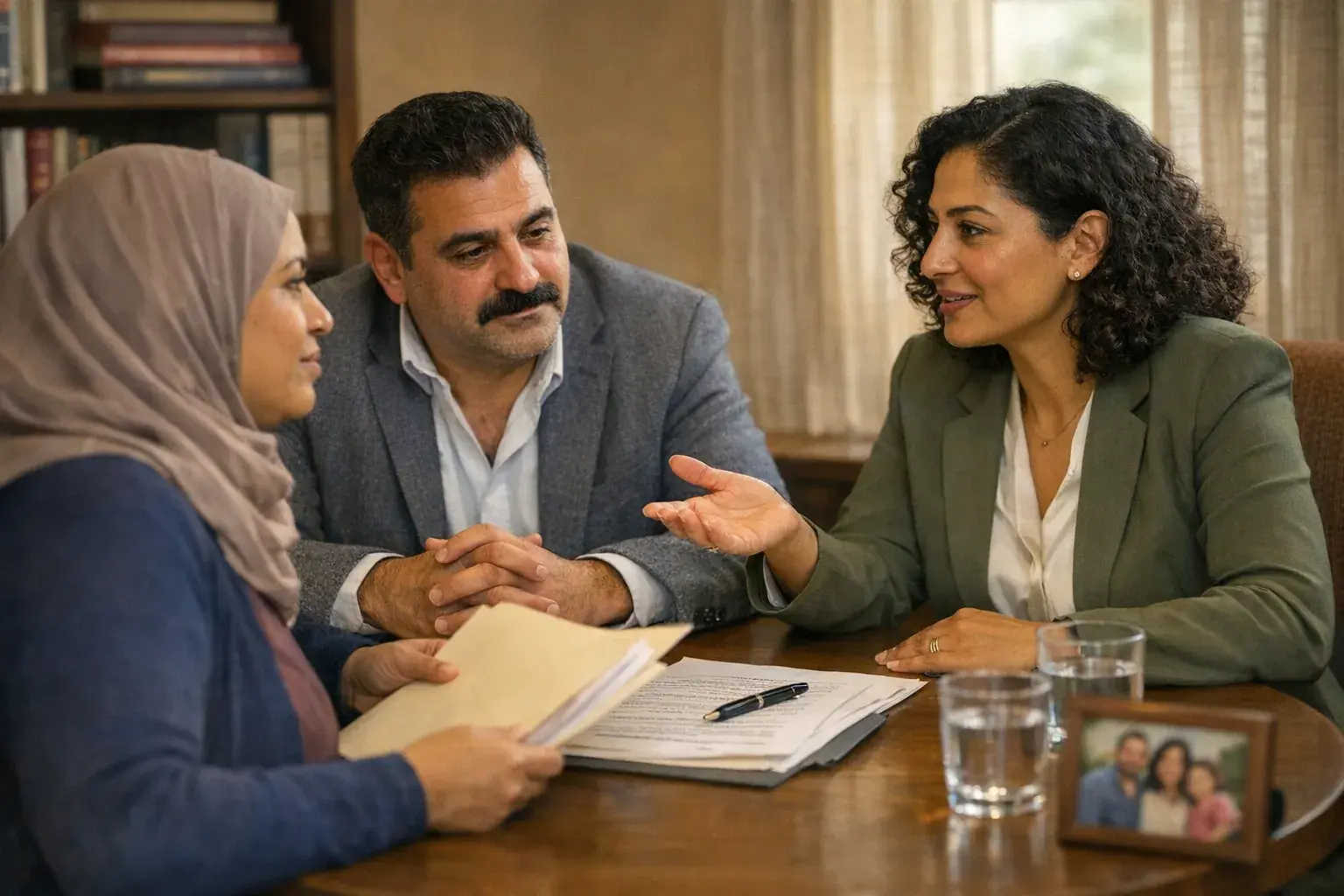
All consultations with Arabic prenuptial & mahr agreements lawyers in our Texas network are completely free and confidential. During your consultation, you'll discuss your prenuptial & mahr agreements situation in Arabic with a qualified attorney who can explain your legal options clearly.
Speak with a lawyer from anywhere in Texas
Most consultations within 24 hours
Free initial consultation guaranteed
Islamic marriage contract expertise including prenuptial agreements, mahr contracts, and postnuptial agreements.
Draft and enforce mahr agreements recognized by US courts.
Prenuptial agreements that respect Islamic traditions and US law.
Protect premarital assets, businesses, and family property.
Clear terms prevent costly disputes if circumstances change.
Legal fees for prenuptial & mahr agreements cases vary depending on the complexity and circumstances. Here's what to expect when hiring an Arabic-speaking prenuptial & mahr agreements lawyer in Texas:
* Fees are estimates and vary by case complexity. Get an exact quote during your free consultation.
Our streamlined process gets you the help you need quickly and efficiently.
We discuss your goals, the mahr terms, property concerns, and business interests. Both parties should have independent legal counsel for the agreement to be enforceable.
We draft the agreement incorporating mahr terms, property provisions, and any other agreed-upon terms. The language satisfies both Islamic requirements and state prenuptial law.
Both parties and their attorneys review the draft, negotiate any changes, and sign the final agreement. Proper execution is critical for enforceability.
Our Texas network includes prenuptial & mahr agreements attorneys experienced with clients from every Arabic-speaking country. Whether you're from the Levant, Gulf, North Africa, or elsewhere, we'll match you with a lawyer who understands your specific background.
Plus attorneys familiar with Kuwaiti, Libyan, Sudanese, Somali, Chaldean, Assyrian, and other Middle Eastern communities
Take the first step—select your legal matter below and get matched with an experienced Arabic-speaking attorney within 24 hours. No fees, no obligation.
Finding the right Arabic-speaking prenuptial & mahr agreements lawyer in Texas doesn't have to be difficult. Here's what to look for when choosing your attorney:
Ask if the attorney speaks Arabic fluently. Can they explain complex prenuptial & mahr agreements concepts in Arabic?
Look for attorneys with proven experience handling prenuptial & mahr agreements cases in Texas.
Look for testimonials specifically from Arab American clients who had prenuptial & mahr agreements cases.
Meet with the attorney before deciding. A free consultation lets you assess their expertise firsthand.
Understanding Texas's family law statutes helps you protect your rights and plan your case. Here's what you need to know.
Cruelty, Adultery, Conviction of a felony, Abandonment (1+ years), Living apart (3+ years), Confinement in a mental hospital
Texas is a community property state. Property acquired during marriage is presumed community property and is divided in a "just and right" manner, which is not always 50/50.
Texas courts can consider fault grounds when dividing property — an adulterous spouse may receive less.
Best interests of the child
Yes
Texas uses "conservatorship" instead of custody. Joint managing conservatorship is the default.
Texas calculates support as a percentage of the non-custodial parent's net resources: 20% for one child, 25% for two, up to 40% for five or more.
Support continues through high school graduation if the child turns 18 during the school year.
Texas has strict limits on court-ordered alimony — maximum 5 years for marriages 10-20 years, 7 years for 20-30, 10 years for 30+.
This information is for educational purposes only and does not constitute legal advice. Laws may change. Consult with an attorney for advice specific to your situation.
When you meet with an Arabic-speaking prenuptial & mahr agreements attorney for your free consultation, ask these important questions:
Directory
Arabic-speaking attorneys serving the Arab community in Texas.
Practice area
22 Arabic-speaking family law attorneys in Texas
Common questions about Arab prenuptial & mahr agreements attorneys in Texas
Are you an Arabic-speaking family law attorney in Texas? Join our network
Looking for an Arabic prenuptial & mahr agreements lawyer near you? Connect with a Arabic-speaking Arab attorney in Texas. Free consultation, 24-hour matching, no obligation.
Disclaimer: The information on this page is for general educational purposes only and does not constitute legal advice. Texas laws may differ from other states. Each case is unique and outcomes depend on specific facts. Contact a qualified attorney for advice specific to your situation.