Speak to a lawyer for freeGet started
Practice Areas
Visas, green cards, citizenship & deportation defense
Car accidents, workplace injuries & malpractice
IRS audits, tax debt relief & international tax
Divorce, child custody, mahr & domestic violence
DUI, drug charges, assault & federal crimes
Coming Soon
Browse by location

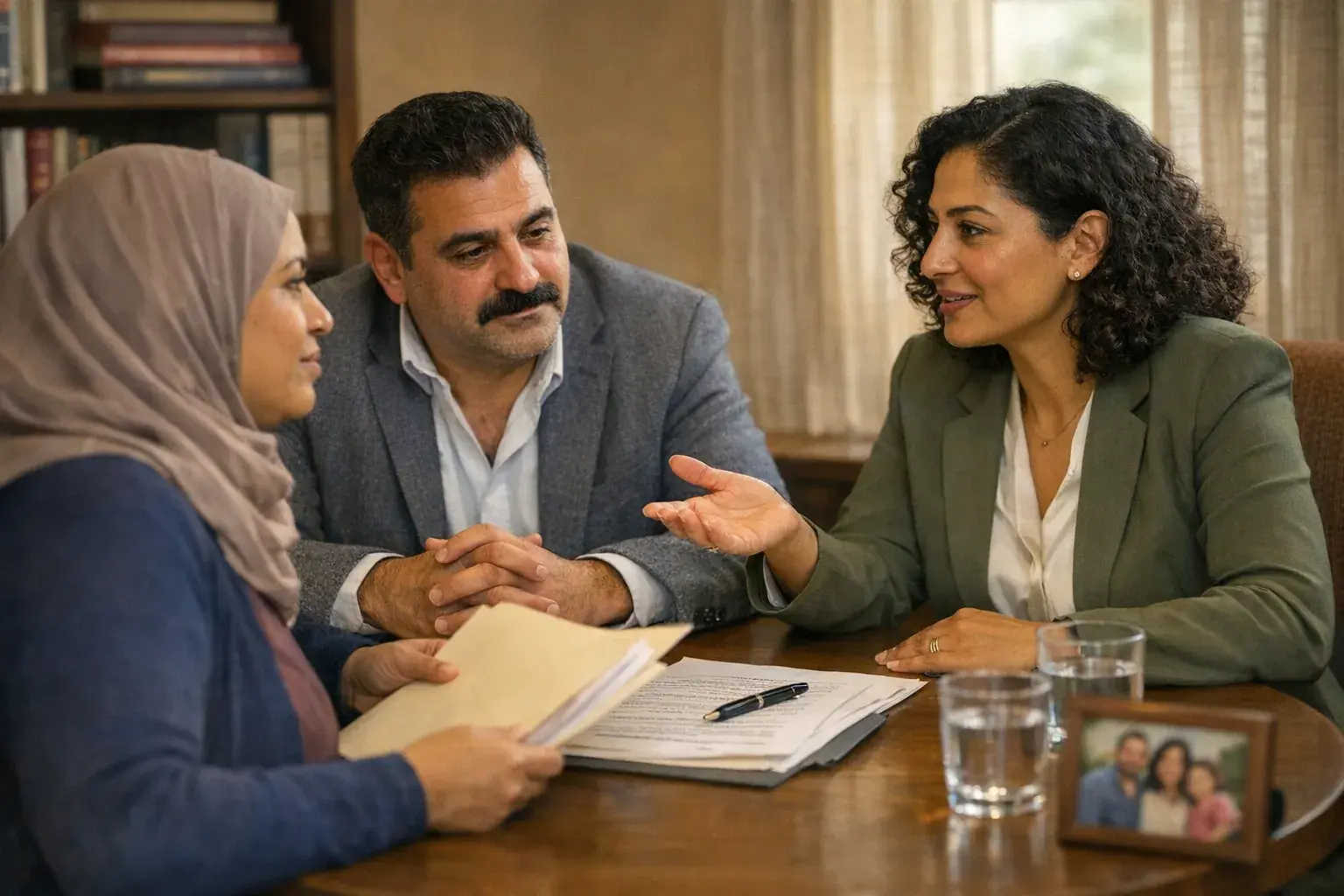
Find a top-rated Arabic family law lawyer in North Carolina. Our Arab attorneys speak your language and understand your culture. Trusted by Iraqi, Syrian, Lebanese, Palestinian & all Arab families.
Find an Arab family law attorney near you. Select your city to see local Arabic-speaking lawyers.
North Carolina is home to a vibrant Arabic-speaking community with 20,000+ residents. Our network serves Arab families across the state.
20,000+
Arabic Speakers
5+
Major Cities
6+
Nationalities
4+
Institutions
North Carolina's Arab American community has grown significantly over the past two decades, driven by the state's booming economy, world-class universities, and expanding refugee resettlement programs. Charlotte, Raleigh-Durham, and Greensboro are the primary centers of Arab life in the Tar Heel State.
Charlotte, the state's largest city and the second-largest banking center in the United States, has attracted Arab professionals in finance, technology, and healthcare. The city's international banking workforce includes a growing number of Arab Americans working at Bank of America, Wells Fargo, Truist, and other major financial institutions headquartered in the Queen City.
The Research Triangle — Raleigh, Durham, and Chapel Hill — is home to a highly educated Arab population connected to North Carolina State University, Duke University, and UNC-Chapel Hill. Many Arab immigrants arrived as graduate students and researchers and built careers in the Triangle's thriving tech, biotech, and healthcare sectors.
Greensboro and the Triad region have become a significant refugee resettlement area, with Iraqi, Syrian, and Palestinian families establishing new roots. The city's lower cost of living compared to Charlotte and the Triangle makes it accessible for newly arrived families.
The Arab community in North Carolina is diverse, with significant Iraqi, Palestinian, Lebanese, Egyptian, Syrian, and Jordanian populations. Mosques, Arabic grocery stores, and community organizations serve these communities across the state's major metropolitan areas.
North Carolina's immigration landscape reflects the state's rapid population growth and economic expansion. The USCIS Charlotte Field Office serves most of the state, handling a growing caseload as North Carolina's immigrant population increases.
The Charlotte Immigration Court processes cases for the western part of the state, while cases from the Triangle and eastern NC are heard through other jurisdictions. Wait times have increased as North Carolina has become a top destination for both employment-based and family-based immigration.
Charlotte has become a major refugee resettlement city, with agencies like the International House and Catholic Charities helping families from Iraq, Syria, and other Arab countries establish new lives. The city's strong job market in banking, healthcare, and logistics provides employment opportunities for resettled refugees.
The Research Triangle's tech and academic sectors drive significant H-1B and employment-based green card activity. Arab professionals at Duke, UNC, NC State, and Research Triangle Park companies frequently navigate complex employer-sponsored immigration pathways.
Fort Liberty (formerly Fort Bragg), one of the largest military installations in the world, creates unique immigration situations for Arab translators and interpreters who served with US forces and are pursuing Special Immigrant Visas.
North Carolina does not have sanctuary city policies, and state law requires local law enforcement to comply with ICE detainers, making criminal defense representation critical for non-citizens.
Population estimates from Arab American Institute, 2023 estimates. Last updated: 2026-03-10.
Discuss your family law case in Arabic without interpreters. Explain complex situations clearly and understand every detail of your legal options.
Work with attorneys who understand Arab family dynamics, cultural values, and community expectations—not just the law.
Lawyers familiar with North Carolina courts, local judges, and state-specific legal procedures that directly affect your case outcome.
Every attorney in our North Carolina network is licensed, verified, and has a track record of success with Arab American clients.
Testimonials
Real reviews from Arab American families who found Arabic-speaking family law lawyers through our North Carolina network.
“My divorce required a full year of separation before we could even file — that's North Carolina law. My attorney handled the equitable distribution of our assets and made sure my mahr agreement was recognized by the court. She spoke Arabic which made discussing personal matters much easier.”

Khaled M.
Durham, North Carolina
2025
“My divorce required the mandatory one-year separation, which was the hardest year of my life. My lawyer helped me plan for custody during the separation and got my mahr enforced when we finally went to court. I have primary custody and a fair property split. She spoke Arabic and understood what I was going through.”

Dania M.
Charlotte, North Carolina
2025
“After losing my job at a Research Triangle company, I couldn't keep up with child support. My ex filed for contempt in Durham County. My lawyer got a modification hearing and the judge adjusted payments based on my real income. He spoke Arabic and treated me with respect during a difficult time.”

Mazen H.
Durham, North Carolina
2025
Looking for an Arabic-speaking family law lawyer near you in North Carolina? Our vetted network connects you with experienced Arab attorneys who understand your language, culture, and legal needs. Every lawyer in our North Carolina network is licensed, reviewed, and has a proven track record serving Arab American families.
Highly rated
Vetted attorneys only
Fluent Arabic
No interpreters needed
Near you
Throughout North Carolina
Free consultation
No obligation
Take the first step—select your legal matter below and get matched with an experienced Arabic-speaking attorney within 24 hours. No fees, no obligation.
Our Arab family law attorneys handle a wide range of cases for Iraqi, Syrian, Lebanese, Palestinian & all Arab clients.
Expert representation for Islamic divorce (talaq), mahr disputes, property division, and contested or uncontested divorce proceedings.
Representation for custody agreements, international custody disputes, visitation rights, and cross-border parental concerns.
Assistance with child support calculations, modifications, enforcement, and interstate support orders.
Emergency protection including restraining orders, safety planning, and protective orders for domestic violence victims.
Islamic marriage contract expertise including prenuptial agreements, mahr contracts, and postnuptial agreements.
Representation for spousal maintenance negotiations, modification petitions, and enforcement of support orders.
Legal fees vary depending on the type of case and complexity. Our North Carolina Arabic-speaking family law lawyers offer transparent pricing and free initial consultations.
* Fees are estimates and vary by case complexity. Get an exact quote during your consultation.
5 case types
6 case types
7 case types
3 case types
5 case types
4 case types
Our North Carolina network includes Arab family law attorneys experienced with clients from every Arabic-speaking country. Whether you're from the Levant, Gulf, North Africa, or elsewhere, we match you with a lawyer who understands your background.
Plus attorneys familiar with Kuwaiti, Libyan, Sudanese, Somali, Chaldean, Assyrian, and other Middle Eastern communities
Understanding North Carolina's family law statutes helps you protect your rights and plan your case. Here's what you need to know.
Adultery, Abandonment (1 year), Cruel treatment endangering life, Excessive use of alcohol or drugs, Incurable insanity (3 years confinement)
North Carolina requires spouses to live separately for a full year before filing for absolute divorce. During separation, spouses may file for post-separation support, equitable distribution, and custody. Fault grounds exist but are rarely used and primarily affect alimony, not property division.
North Carolina is an equitable distribution state. Marital property is divided fairly but not necessarily equally. The court considers 12 statutory factors including length of marriage, age, health, income, and contributions of each spouse.
Mahr agreements may be considered as part of property division or as a contractual obligation. North Carolina courts have addressed mahr in several cases, generally treating it as an enforceable contract if it meets basic contract requirements.
Best interests of the child
No
North Carolina does not have a statutory preference for joint custody. The court has broad discretion to fashion custody arrangements in the child's best interests. Parenting plans can be submitted by agreement. Custody can be modified upon showing a substantial change in circumstances.
North Carolina uses the income shares model based on both parents' gross incomes, number of children, and custodial arrangement. The NC Child Support Guidelines provide worksheets for calculating support obligations.
Support ends at 18 or high school graduation, whichever is later, but not beyond age 20. North Carolina does not require parents to pay for college. Support orders can be modified upon showing a change in circumstances of at least 15%.
This information is for educational purposes only and does not constitute legal advice. Laws may change. Consult with an attorney for advice specific to your situation.
Choosing the right Arabic-speaking family law lawyer in North Carolina is important. Here are the key qualities to evaluate:
Verify the attorney speaks Arabic fluently—not just conversationally. Can they explain complex family law concepts in Arabic? Do they speak your dialect?
Look for attorneys with specific experience in your type of family law case. Ask how many similar cases they've handled and their success rate.
Look for testimonials specifically from Arab American clients. Their experience working with the attorney will be most relevant to yours.
Confirm the attorney is licensed and in good standing with the North Carolina bar. Check for any disciplinary history.
During your consultation with an Arabic-speaking family law attorney, ask these important questions:
Common questions about hiring an Arab family law attorney in North Carolina.
Directory
Arabic-speaking attorneys serving the Arab community in North Carolina.
Comprehensive guides to help you understand your immigration options. For personalized advice in North Carolina, consult with one of our Arabic-speaking attorneys.
Arab immigration attorneys walk you through I-130, I-140, adjustment of status & consular processing. Family-sponsored and employment-based paths explained.
Arabic-speaking attorneys explain the N-400 naturalization process, civics test prep, English requirement waivers & dual citizenship rules for Arab immigrants.
Arab refugee lawyers explain asylum eligibility, the I-589 application, credible fear interviews & immigration court hearings. Build a stronger protection case.
Arabic-speaking deportation attorneys explain removal proceedings, cancellation of removal, asylum defense & ICE encounter rights for Arab immigrants in the U.S.
Other Legal Services
Our network also provides these legal services with Arabic-speaking attorneys.
Are you an Arabic-speaking family law attorney in North Carolina? Join our network
Our vetted Arab family law lawyers in North Carolina are ready to help. Free consultation, no obligation. Available for Iraqi, Syrian, Lebanese, Palestinian & all Arab families.